Stewart G Smith
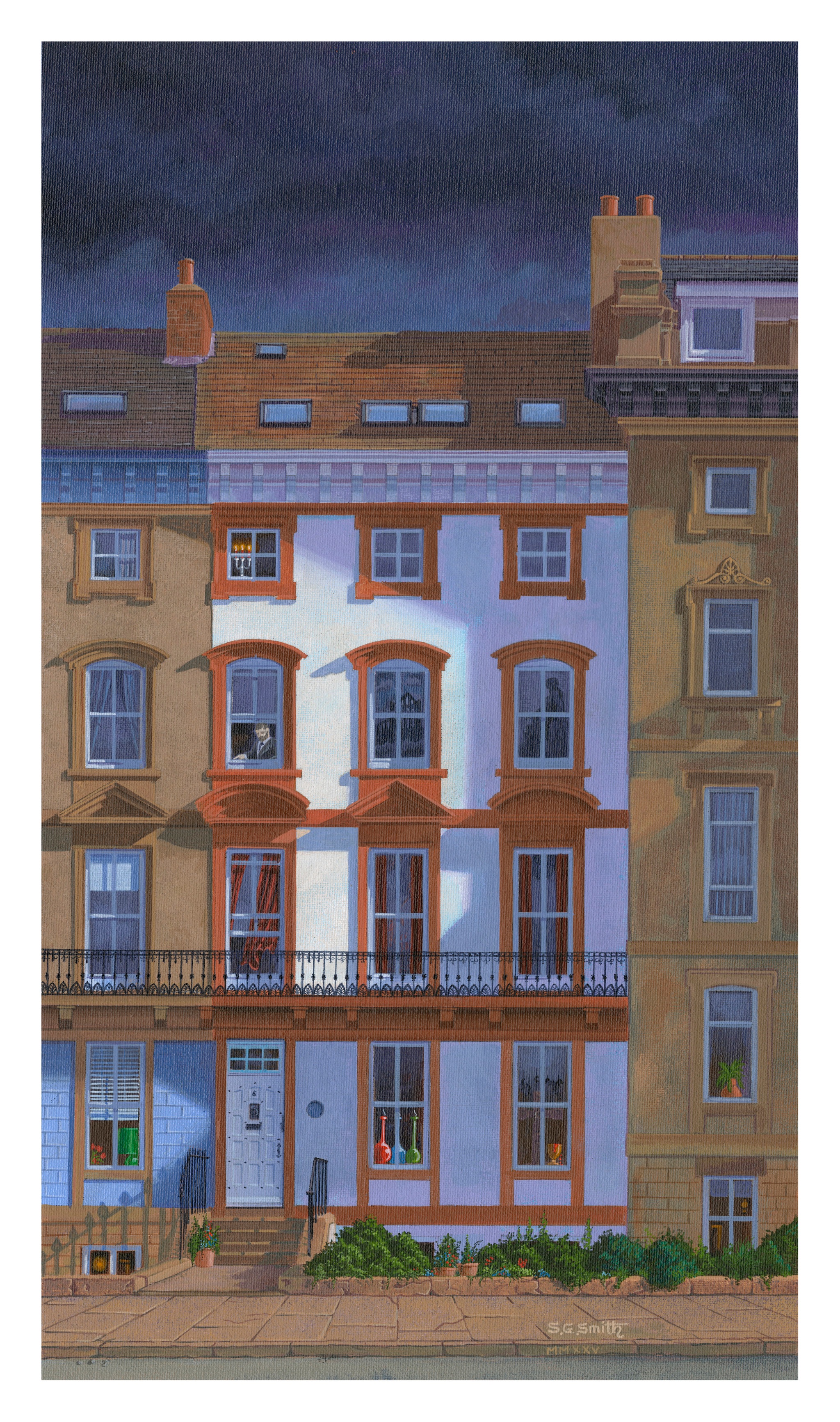
Title: 6 Royal Crescent, Whitby
The address and its association with Dracula made it an easy and worthy subject to choose for creating an architectural painting. Subtle changes have been made, such as replacing the modern windows back to the traditional sash design. In one of the windows there is Bram Stoker, another open window shows the red curtains billowing in the wind from the approaching storm, and there are also hidden clues and symbolism too amongst the composition.
Bram Stoker travelled by train from London and arrived at Mrs Veazy’s guesthouse at 6 Royal Crescent on August 11th 1890, he was joined by his wife Florence and their son Noel a week later.
At the time Stoker already had several ideas for a vampire story in the development stages that were influenced from his early childhood illnesses which left him almost totally bedbound for his first seven years to his miraculous transformation to an athletic champion during his time at university. Bram had already started doing his research at this point and had planned to set his vampire tale in Austria and have the Count arrive in England in Dover.
Throughout his stay Bram liked to wander around the town gathering local tales and superstitions from the locals and wandering amongst the tombstones of St Mary’s churchyard on the East cliff and the nearby Abbey. Whilst talking with the local seafarers and townsfolk he also discovered the story of the Russian vessel “Dmitry” from Narva that was carrying a cargo of silver sand that ran aground during a storm onto Tate Hill Sands in late October five years previously. Stoker changed the name of the ship to “The Demeter” from Varna that carried Count Dracula and his 50 crates of earth.
During his research at “The Whitby Subscription Library and Museum”, (now the Quayside Restaurant), he discovered two particular books with information that drew his attention. The first was “The Glossary of Words from the neighbourhood of Whitby” by the local chemist F K Robinson that mentioned the local word for Devil was “Bad Lad” and that “Barguests” or “Boh-ghosts” meant terrifying apparitions taking shape as human or animal. The second book was a publication from 1820 by a British consul in Bucharest “William Wilkinson” entitled “An account of the Principalities of Wallachia and Moldavia”. Here Wilkinson writes “Dracula in the Wallachian language means Devil”. Wallachians were accustomed to giving this as a surname to any person who rendered himself conspicuous by courage, cruel actions or cunning!
He would also spend time in the reading room of The Royal Hotel which provided him with a quiet place to write and offer views of the ships in the harbour and Whitby Abbey. Bram’s travels also took him to Cruden Bay, also known as Port Erroll in Scotland, which has the ruins of Slains Castle, Bram used the internal layout of this castle for that of his fictional Castle Dracula. Further studies in The British Museum Library provide Bram with plenty of useful information about Transylvanian Superstitions, Vampirism, train routes, maps, and even more details about Vlad Dracula the Impaler.
Dracula was first published by Archibald Constable and Company on 26th May 1897 with just three thousand copies at six shillings each. The hardback cover in yellow cloth symbolises death and decomposition, the red text refers to blood.
Bram Stoker died at his home in Pimlico, London aged 64 on 20th April 1912. His ashes and those of his son Noel are interred together in an ornamental urn in the East Columbarium at Golders Green Crematorium that is open to the public.
Status: Unavailable
Prints: Available as prints
Kind: Painting
Size of artwork: 51.2cm x 30.3cm x .4cm
Style: Ask the artist
Including frame:
64.7cm x 43.8cm x 4cm
Media: Acrylic
Surface: Canvasboard
Where to buy: Online only
Title: 6 Royal Crescent, Whitby
The address and its association with Dracula made it an easy and worthy subject to choose for creating an architectural painting. Subtle changes have been made, such as replacing the modern windows back to the traditional sash design. In one of the windows there is Bram Stoker, another open window shows the red curtains billowing in the wind from the approaching storm, and there are also hidden clues and symbolism too amongst the composition.
Bram Stoker travelled by train from London and arrived at Mrs Veazy’s guesthouse at 6 Royal Crescent on August 11th 1890, he was joined by his wife Florence and their son Noel a week later.
At the time Stoker already had several ideas for a vampire story in the development stages that were influenced from his early childhood illnesses which left him almost totally bedbound for his first seven years to his miraculous transformation to an athletic champion during his time at university. Bram had already started doing his research at this point and had planned to set his vampire tale in Austria and have the Count arrive in England in Dover.
Throughout his stay Bram liked to wander around the town gathering local tales and superstitions from the locals and wandering amongst the tombstones of St Mary’s churchyard on the East cliff and the nearby Abbey. Whilst talking with the local seafarers and townsfolk he also discovered the story of the Russian vessel “Dmitry” from Narva that was carrying a cargo of silver sand that ran aground during a storm onto Tate Hill Sands in late October five years previously. Stoker changed the name of the ship to “The Demeter” from Varna that carried Count Dracula and his 50 crates of earth.
During his research at “The Whitby Subscription Library and Museum”, (now the Quayside Restaurant), he discovered two particular books with information that drew his attention. The first was “The Glossary of Words from the neighbourhood of Whitby” by the local chemist F K Robinson that mentioned the local word for Devil was “Bad Lad” and that “Barguests” or “Boh-ghosts” meant terrifying apparitions taking shape as human or animal. The second book was a publication from 1820 by a British consul in Bucharest “William Wilkinson” entitled “An account of the Principalities of Wallachia and Moldavia”. Here Wilkinson writes “Dracula in the Wallachian language means Devil”. Wallachians were accustomed to giving this as a surname to any person who rendered himself conspicuous by courage, cruel actions or cunning!
He would also spend time in the reading room of The Royal Hotel which provided him with a quiet place to write and offer views of the ships in the harbour and Whitby Abbey. Bram’s travels also took him to Cruden Bay, also known as Port Erroll in Scotland, which has the ruins of Slains Castle, Bram used the internal layout of this castle for that of his fictional Castle Dracula. Further studies in The British Museum Library provide Bram with plenty of useful information about Transylvanian Superstitions, Vampirism, train routes, maps, and even more details about Vlad Dracula the Impaler.
Dracula was first published by Archibald Constable and Company on 26th May 1897 with just three thousand copies at six shillings each. The hardback cover in yellow cloth symbolises death and decomposition, the red text refers to blood.
Bram Stoker died at his home in Pimlico, London aged 64 on 20th April 1912. His ashes and those of his son Noel are interred together in an ornamental urn in the East Columbarium at Golders Green Crematorium that is open to the public.