Stewart G Smith
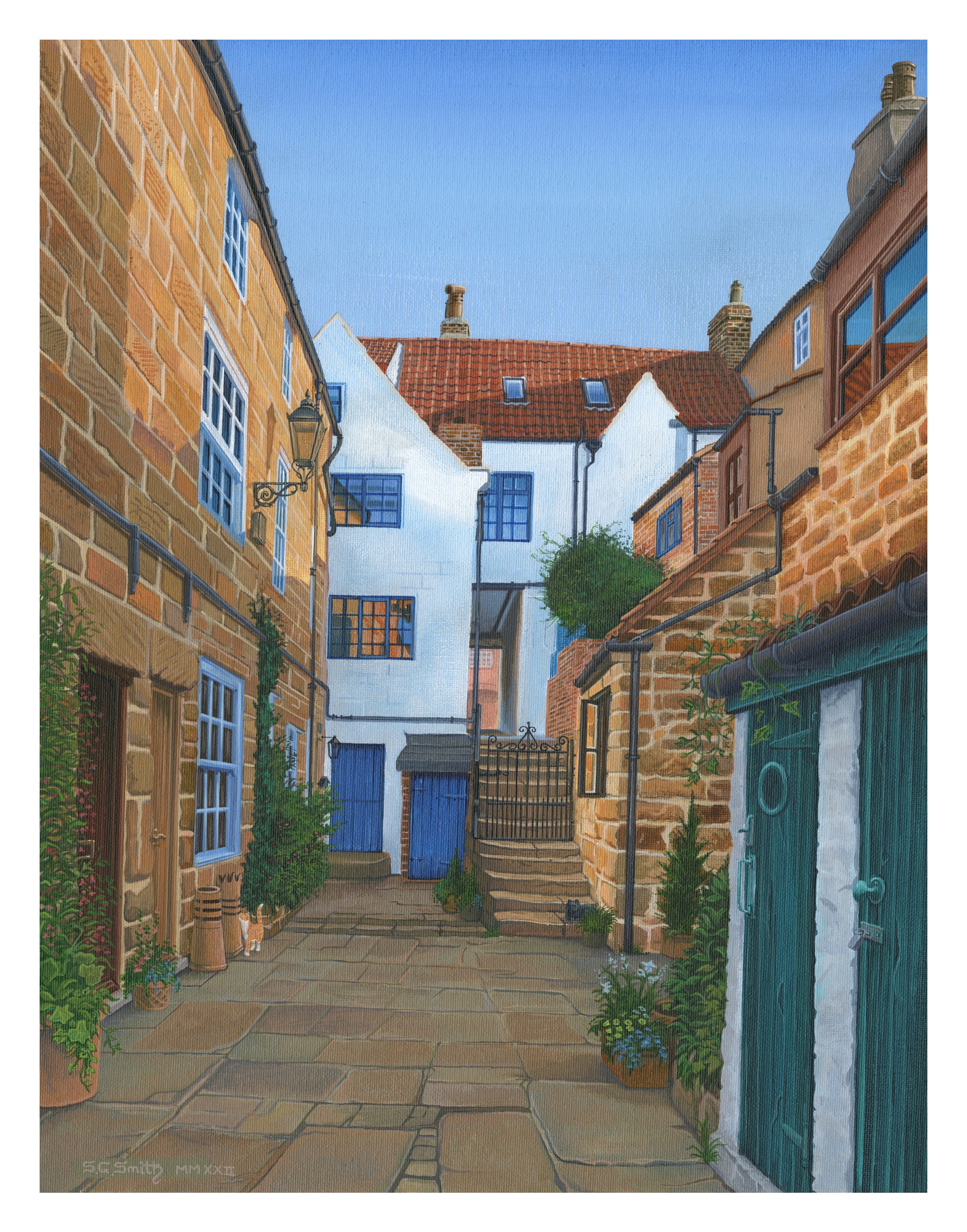
Title: View From Kiln Yard, Whitby
Looking out, and facing North towards Tate Hill, the arched brick passageway of Kiln Yard creates an interesting frame for the Fishermen’s Cottages on the left, that date back to approximately 1746, and you will find the base of the 199 steps opposite them. Records for the steps date back as far as 1340, although their history stretches back much further than this. Originally the steps that lead up the East Cliff were made of wood, but in 1774 the timber was replaced with stone sourced from the nearby Sneaton Quarry. Today a weary traveler may well pause for a minute or two on one of the benches as they climb the steps, however if anyone should experience a chill running down their spine, perhaps it is because the benches were originally placed there for the purpose of being coffin rests for the pallbearers taking the departed to St Mary’s Church which is situated at the summit of the East Cliff.
Status: Unavailable
Prints: Available as prints
Kind: Painting
Size of artwork: 43.5cm x 33.3cm x .4cm
Style: Contemporary
Including frame:
55cm x 44.8cm x 4cm
Media: Acrylic
Surface: Canvasboard
Where to buy: Ask the artist
Title: View From Kiln Yard, Whitby
Looking out, and facing North towards Tate Hill, the arched brick passageway of Kiln Yard creates an interesting frame for the Fishermen’s Cottages on the left, that date back to approximately 1746, and you will find the base of the 199 steps opposite them. Records for the steps date back as far as 1340, although their history stretches back much further than this. Originally the steps that lead up the East Cliff were made of wood, but in 1774 the timber was replaced with stone sourced from the nearby Sneaton Quarry. Today a weary traveler may well pause for a minute or two on one of the benches as they climb the steps, however if anyone should experience a chill running down their spine, perhaps it is because the benches were originally placed there for the purpose of being coffin rests for the pallbearers taking the departed to St Mary’s Church which is situated at the summit of the East Cliff.